
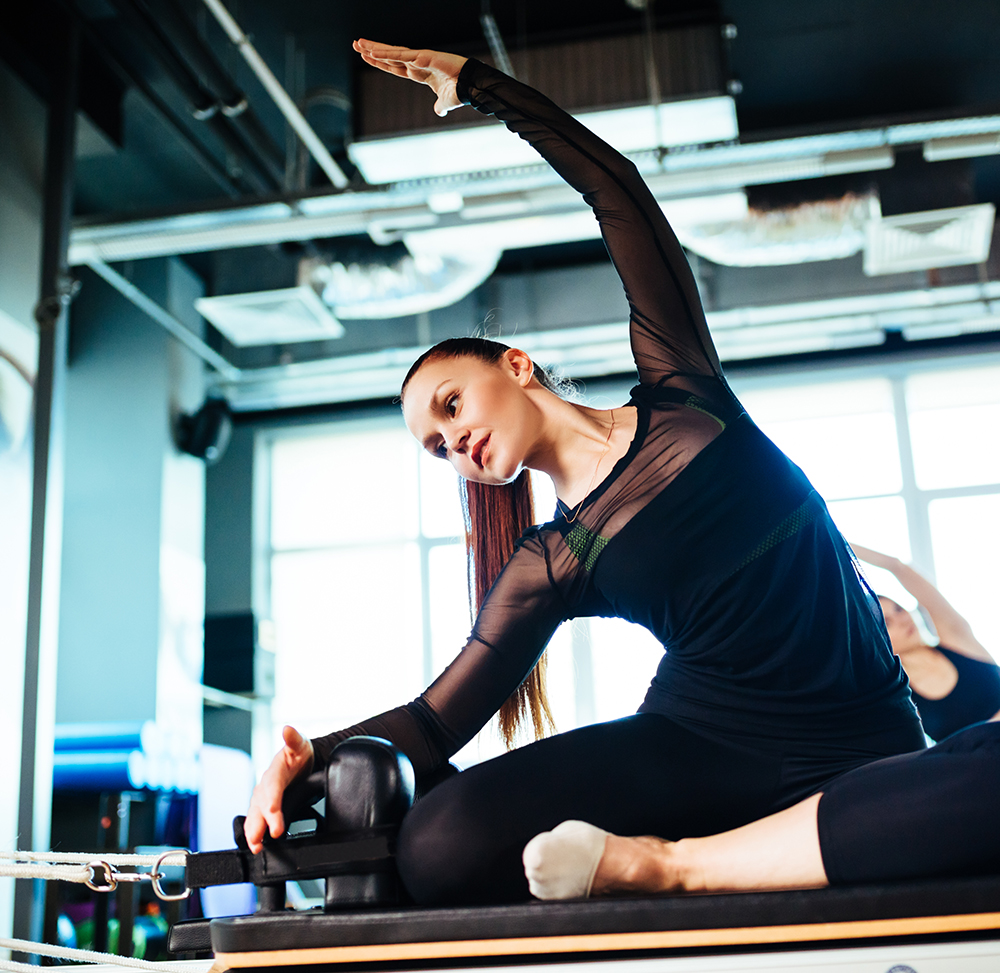
Reformer Pilates at Surf Fit, Newquay. The reformer will help you to build your strength, coordination, flexibility and balance. Target your muscles with laser precision.
With reformer Pilates you’ll work your muscles through the full range of motion, perfect for increasing flexibility while building strength. Pushing and pulling against the resistance of the springs, carriage and body weight makes this a unique, full-body workout.
Reformer Pilates is highly focused, allowing you to work every muscle in your body. If you have specific fitness goals that you want to achieve, then reformer Pilates is for you. Fun, effective, and fast.
One-to-one and duet sessions will allow you to grow and progress much faster than in a group reformer pilates class. Surf Fit is safe space where you can concentrate on your movement journey without the distraction of others around you.
Each session is designed to challenge you while ensuring you feel supported and motivated. Whether you’re a beginner or an experienced practitioner, my tailored approach will help you unlock your potential and redefine your limits.
REFORMER BENEFITS
Functional strength
Efficient movement
Improved balance
Better coordination
Back pain relief
One-to-one Session
£45
Share the cost bring a mate
£22.50
(per person)
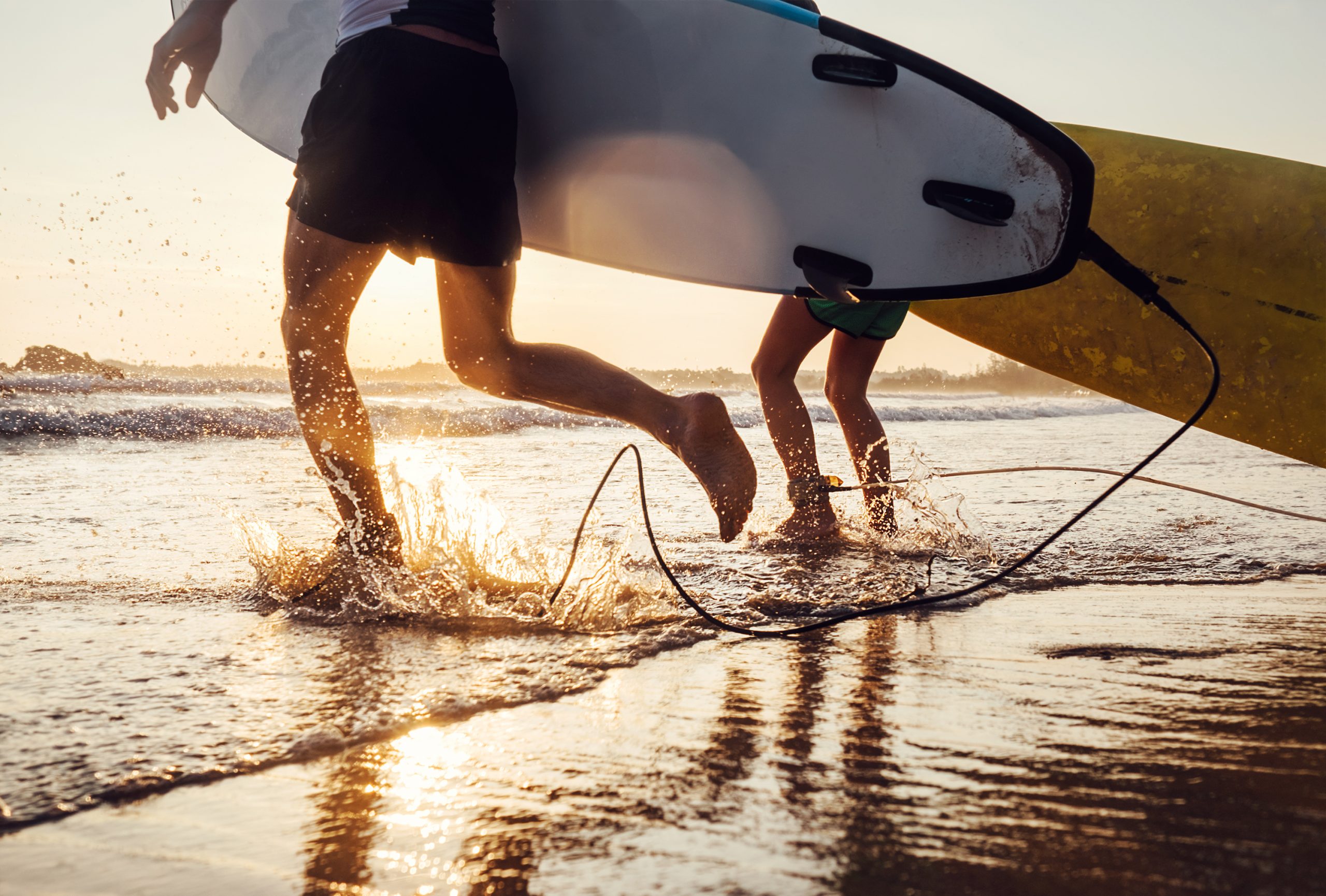
Surfing, cycling, running, rugby or whatever it is you like to do for fun, Reformer Pilates will compliment those activities; increasing your strength, mobility and performance.
You’ll gain greater awareness of your body and posture, drastically reducing the chances of injury and back pain, keeping you doing the things you love for longer!
FAQ’s
What the hell is Pilates Anyway?
Pilates is a dynamic, low impact but high intensity exercise system used to strengthen the core and peripheral muscle groups to restore the natural shock absorbing properties of the spine.
Pilates takes its name from Joseph Pilates, a German guy who lived in Britain and later in America. He developed the Pilates method as a new approach to exercise and body-conditioning near the beginning of the last century. His method included the use of equipment referred to by him as ‘apparatus’. Probably the best known piece of equipment, is the Pilates reformer.
Joseph Pilates was born near Dusseldorf in 1880. He was ill for a lot of his childhood, and as a consequence, he grew up determined to make himself strong and healthy. He took up bodybuilding as a teenager and before he knew it he was getting work as a model for anatomical drawings.
Pilates was probably one of the first influential figures to combine Western and Eastern concepts on health and fitness. He studied and practised every kind of exercise he could find; ranging from ancient Roman and Greek exercise modalities to body-building and gymnastics. He also studied the Eastern disciplines of tai chi, martial arts, yoga and Zen meditation. On top of all this he researched and studied human anatomy and also the movement of animals. Totally focused on his goals, Joseph sampled every kind of exercise that he could, meticulously recording his findings.
He left Germany in 1912, aged 32, moving to the UK where he became a professional boxer. Never idle, he was a diver, an expert skier, taught self-defence to Scotland Yard police detectives, and also found work as a circus acrobat.
Development of Pilates and the Pilates Reformer
When the first World War broke out, the British arrested and locked him in an internment on the Isle of Mann as a German enemy alien. With not much else to do he used his time to begin developing a new approach to exercise and full body conditioning, the start of what is known today as Pilates. During his internment he also got the chance to work as a nurse. This allowed him the opportunity to experiment on his patients (different times) by attaching springs to hospital beds, so that patients could start toning their muscles even while they were still stuck in their beds.
This was the origin of the first Pilates machine now known as the Pilates Reformer. Initially the Reformer was shaped like a sliding bed using springs as resistance.
After the war he returned to Germany briefly before moving to the USA in 1923
The First Pilates Studio
He opened his first studio in SoHo, New York along with Clara his assistant, and later his wife, who he’d met on the Atlantic crossing.
His new method was an instant hit, particularly amongst the ballet community. They found the Pilates method the best way both to recover from injuries and to prevent their recurrence. Gradually, a more people got to hear of it the method.
Pilates initially called his technique ‘Controlology’ – but later did it become known by his own surname. He conceived it as mental conditioning as well as a physical in which people could work their mind and bodies to their full potential.
When explaining the guiding principle of Controlology, he liked to quote Schiller, a famous German playwright: ‘lt is the mind itself which builds the body’.
When will I start to notice the Results?
Joseph Pilates said:
‘In ten sessions you will feel the difference; in 20 you will see the difference; and in 30 you will have a whole new body’.
Most people do start to feel a difference after 10 sessions, getting the sense that they are walking taller and moving in a looser, more supple way.
The longer you continue with Pilates, the more you’ll see and feel the shape of your body changing.
What Should I wear to a Reformer lesson?
Wear comfortable clothing that you can move in. It doesn’t necessarily need to be form fitting, but tighter clothing allows the instructor to see that the exercises are being done correctly.
Please don’t wear clothes that have metal zips or buckles as they can damage the Reformers.
Wear socks or go barefoot in the studio, shoes are are a no go.
HOW DO I START?
It’s really easy, just click on the ‘Book Now’ button. Choose the activity you’d like to do along with the session date and time. You’ll need to sign the declaration and complete a screening form. Then you’re all set.
This form is a liability insurance prerequisite, but it’s also to let me know what your fitness goals are, whether you have had any old injuries or operations that might have a bearing on the kind of exercises that I’ll programme for you, your fitness history etc.
Sessions can be booked individually as it suits, but if you have a preferred time slot I’d recommend block booking.
WHAT DOES PILATES DO THAT OTHER TYPES OF EXERCISE DON'T
Most exercise systems strengthen your body’s bigger muscles, but Pilates works on the smaller ones too. The unusual thing about Pilates as an exercise is that you’ll strengthen your muscles as the lengthen, and also as they shorten. In other modalities there is normally an instant when your muscles get a chance to relax before moving again.
This results in a stronger, balanced body, with increased mobility through your joints, a firm musculature and good, natural posture.
Pilates will help you to achieve a natural, balanced posture by strengthening the centre of your body, your core, so that it supports your lower back, helping you to stand tall and strong, and hold your upper body correctly.
Many kinds of exercise aim only to raise your general level fitness. A Pilates instructor can help you to isolate and strengthen specific muscle groups or tackle a particular problem with precision.
Other exercise systems can often cause injuries. Pilates exercises can not only can treat injuries, but they are so controlled and low impact, that they’re extremely safe to practice – if they’re taught by a properly trained instructor. As a bonus, the body awareness that you’ll develop will help you to avoid the same injuries or problems recurring in the future.
Pilates is a dynamic, low impact, non-aerobic exercise method, which produces a healthy, toned and mobile body.
Can anyone do Pilates?
Yes! Pilates is a super versatile exercise system that you can slot into your life to compliment whatever it is you like to. Whether you’re young or old, large, or small, a pro-surfer, a golfer, male or female, there are huge benefits to be had by everybody.
How often should I do Pilates?
People do Pilates anywhere from once a week to once a day – but twice a week is common and what I’d suggest for most clients.
Even if you can just take one session a week, I’d recommend that you should try to do at least a few minutes of Pilates – whether at home or work – on a daily basis.
Can I Bring a Mate?
Yes you can! I have two Reformers in my home studio so you can make your sessions a social event and bring a friend. This will make it cheaper as you’ll share the cost of the session between you both. Oh, and if you surf, I’m a short walk to Tolcarne and Great Western beaches, so you can go for a surf afterwards.
Newquay Studio Hours
Monday – Thursday:
Dawn patrol: 07:00 – 08:00
First session: 08:30 – 09:30
Second session: 10:00 – 11:00
Third session: 12:00 – 13:00
Sundowner: 17:30 – 18:30
SESSIONS BY APPOINTMENT